File 05 Thrusters · fan suction
How the Tesla Roadster “flies”
No wings, no rotors, no jet fuel. The Roadster pairs a fan-car suction system with cold-gas thrusters — bottles of compressed air vented through nozzles — to stick to a ceiling one moment and leap off it the next.
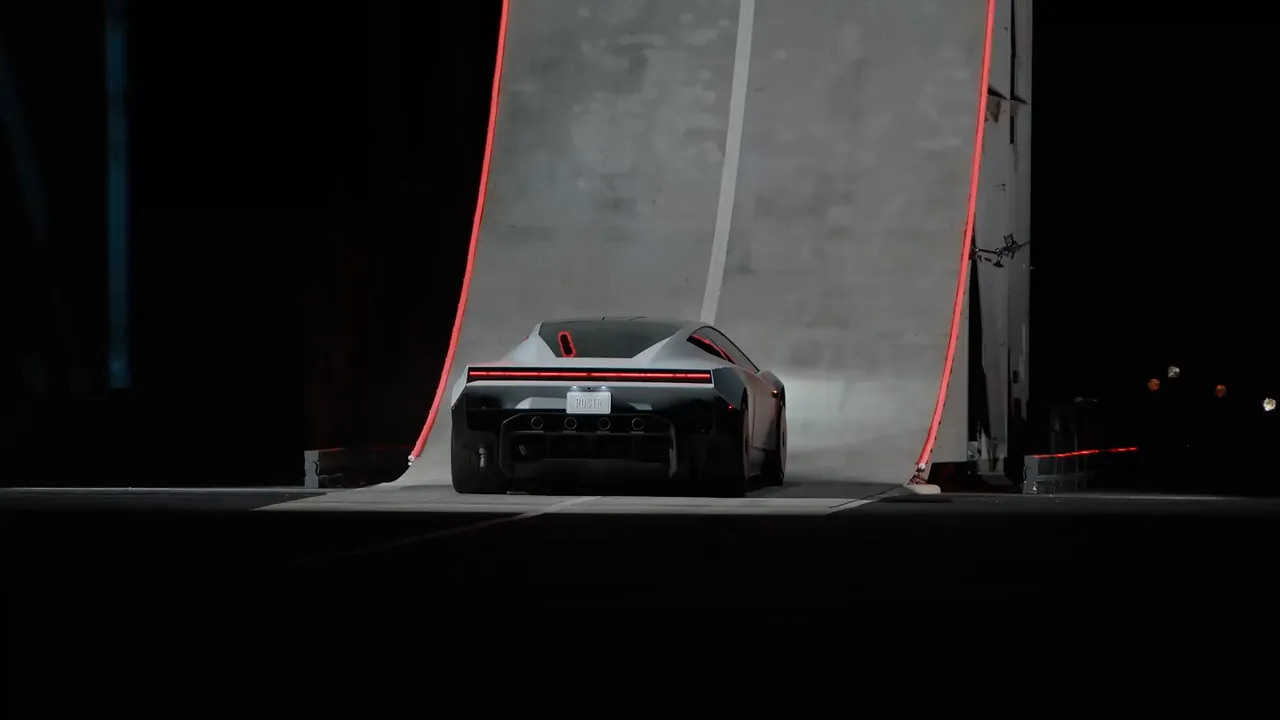
01 System layout
Two systems, one stunt
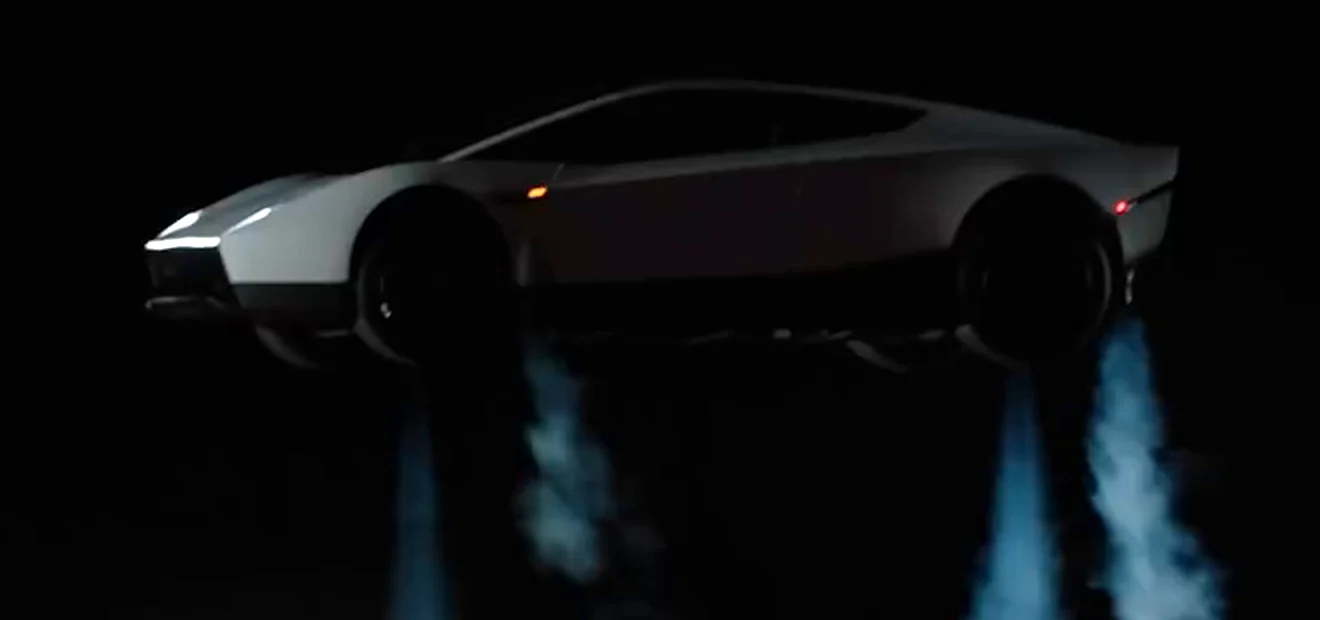
Rear thrusters ×4
Styled like exhaust tips in the rear diffuser, with a claimed 80 kN of thrust for launches — the “main thrusters in the rear” Musk described.
Underside thrusters ×4
Pointing down near each wheel for lift — the four jets visible in this frame. These made the hops, including the flip over five Teslas.
Nose thrusters ×2
Fire sideways for yaw control, working with the others to rotate and steady the car in the air.
Suction fan + skirts
Pull air out from under the sealed floor for up to 2 g of downforce — enough to hang upside down, even stationary.
Main gas tank, ~200 L
A carbon-overwrapped pressure vessel behind the seats on thrust-equipped cars. Tesla says it can be recharged.
Extra tank, ~400 L
Rocket only. It takes the passenger's place, which is why Rocket is a single-seater.
Active wings
A hidden front wing in the nose intake and a moving rear wing, driven by actuators derived from Tesla's Optimus robot.
Pop-out barge boards
A panel behind each front wheel deploys in Track Mode to steer air along the body.
02 Downforce
The suction fan: how it drives upside down
Wings and diffusers only make downforce at speed — even a Formula 1 car would need to be going very fast to stick to a ceiling. A fan car cheats: it seals the floor to the road with skirts and uses fans to suck the air out, so the atmosphere presses the car down even at a standstill.
Tesla calls its version a multi-mode fan and ground-sealing system. Vehicle engineering VP Lars Moravy said it can “pull up to 2 Gs” — twice the car's weight. Hanging upside down needs just over 1 g, which is why the Roadster could climb a ramp that curled overhead and stay put.
The idea is decades old. The Chaparral 2J ran a fan in 1970 Can-Am racing, Brabham's BT46B won a Formula 1 race with one in 1978 before it was withdrawn, and modern cars like the Gordon Murray T.50 and McMurtry Spéirling revived it. On the Roadster it doubles as a cornering aid: Tesla says it allows more than 2 g in corners, and the Track Mode screen lets drivers set the aero load up to “Max Grip.”
03 SpaceX tech
Cold-gas thrusters: a rocket with no fire
A cold-gas thruster is the simplest rocket there is: a tank of high-pressure gas, a valve and a nozzle. Open the valve and the escaping gas pushes the other way. There is no combustion, no flame and no fuel to burn — just air to refill. Spacecraft use them for fine attitude control, and SpaceX uses nitrogen cold-gas thrusters to turn Falcon 9 boosters around after stage separation.
Tesla's engineering chief Lars Moravy said the Roadster runs ten thrusters fed by 600 liters of compressed air — about 250 kg of it, according to Hagerty. MotorTrend and Electrek describe a 200 L carbon-overwrapped tank behind the seats, with the Rocket version adding a 400 L tank in place of the passenger seat, at up to 10,000 psi. Tesla calls it compressed air; MotorTrend and InsideEVs report the gas is nitrogen.
Musk pitched exactly this in 2018 as a “SpaceX option package” of about ten small thrusters arranged around the car, joking that they might even let a Tesla fly. Eight years later, they did — briefly.
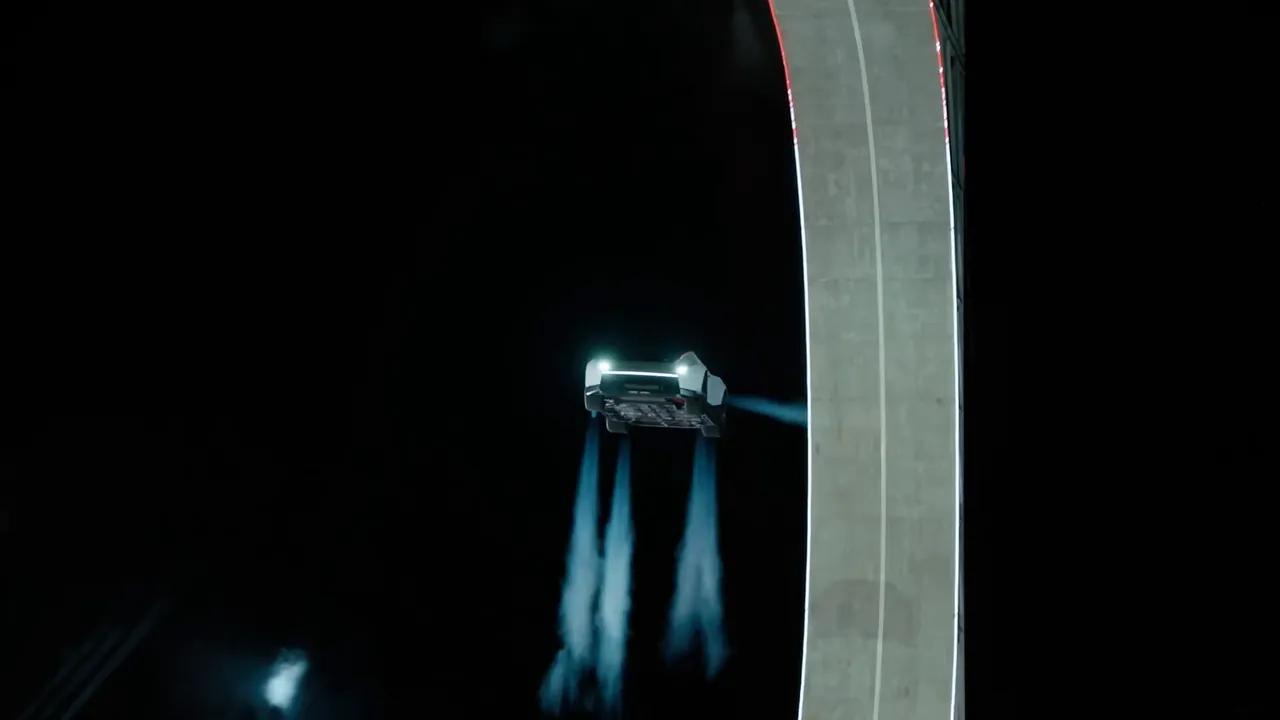
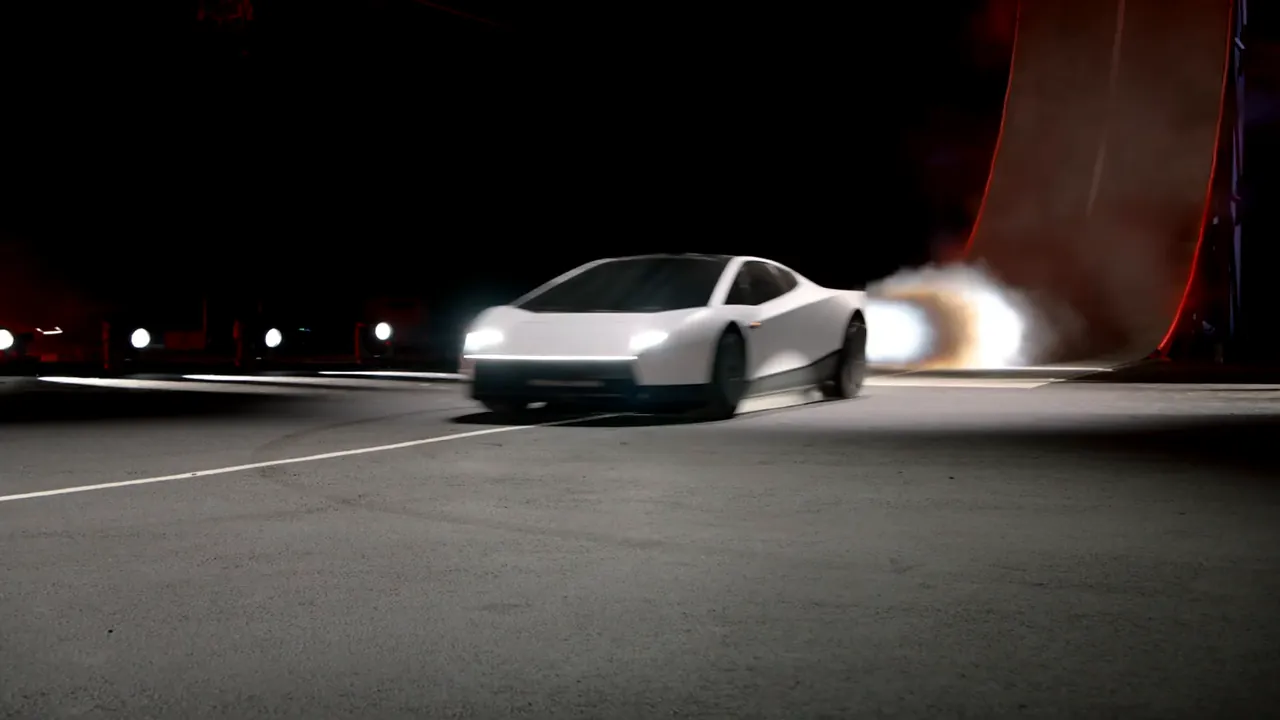
04 Flight sequence
From ramp to landing in four moves
Lock
Fans seal the car to the curved ramp as it climbs past vertical and goes inverted.
Release
At the top the car lets go of the surface and launches off the ramp.
Rotate
Thrusters fire in combination to spin the car right side up in mid-air.
Land
Underside jets ease the descent so it settles onto its wheels.
Watch Tesla's footage of the full run on the video page.
05 The physics
Can compressed air really make a car fly?
Lift is not the problem — duration is. Cold-gas thrusters are powerful but inefficient: compressed gas carries little energy for its weight compared with rocket propellant, so a tank empties fast at full thrust. InsideEVs reports that one charge lasts roughly five to six seconds, and refilling takes hours (two to six by InsideEVs' account, six to seven by Electrek's), with a goal of about half an hour.
Back-of-envelope Our estimate
- Weight: ~1,700 kg × 9.81 m/s² ≈
16.7 kN - Claimed thrust from the four rear thrusters:
80 kN→ about 5× the car's weight - Stored gas: 600 L at up to 10,000 psi; Hagerty reports about
250 kg - Cold-gas efficiency: specific impulse of roughly
50–70 sfor air, versus ~300 s for a kerosene rocket engine - Total impulse ≈ mass × Isp × g ≈
120–170 kN·s→ about1.5–2 sat a full 80 kN
Thrusters rarely all fire flat out, which is how a charge stretches to the reported five to six seconds. Either way it is seconds of thrust, not minutes — short, violent hops, which is why experts say it hops rather than flies.
06 Context
Why it's not a flying car like an eVTOL
Air-taxi companies such as Joby and Archer build eVTOLs that lift off on electric rotors and cruise for many miles, and they have spent years working through FAA certification.
The Roadster is a different idea: a sports car that borrows rocket hardware for moments of extreme acceleration and acrobatics. It has no wings or rotors for sustained lift, and the FAA told CBS News it doesn't meet the agency's definition of an aircraft. If it is a flying car, it is one that flies the way a skateboarder does — off a ramp, for a moment.
07 Quick answers
Engineering FAQ
How does the flying Tesla Roadster work?
Two systems. A fan-and-skirt suction system pulls the car onto the road with up to about 2 g of downforce, enough to hold it upside down. Cold-gas thrusters developed with SpaceX blast high-pressure gas (Tesla calls it compressed air; MotorTrend reports nitrogen) from nozzles at the rear, underside and nose to push, lift and rotate the car. There is no combustion and no jet engine.
See the diagram →How many thrusters does the Roadster have?
Tesla's engineering chief Lars Moravy said the system uses ten thrusters fed by 600 liters of compressed air. Reports describe four at the rear, four pointing down near the wheels for lift and two at the nose firing sideways for yaw control. The Thrust version has rear thrusters only; the full set is on Rocket.
Can the Tesla Roadster actually fly?
Only briefly. The demo car launched off a ramp, rotated in mid-air, flipped over a row of Tesla vehicles and corkscrewed up from a standstill, each move lasting seconds. InsideEVs reports one charge of the thrusters lasts roughly five to six seconds. Before the event, the Smithsonian's curator of vertical flight told CNN, “We are literally talking about hopping.” It is not an aircraft in the eVTOL sense.
How the thrusters work →What does SpaceX have to do with the Roadster?
The cold-gas thrusters were developed with SpaceX, the reveal was held at a SpaceX test site, and Musk first pitched the idea in 2018 as a “SpaceX option package.” CNBC noted the collaboration fuelled speculation about a closer Tesla–SpaceX tie-up.
REF Reporting we relied on
Sources
Figures marked as claims come from Tesla's event and reservation pages as reported by these outlets. None have been independently tested yet.
- The DriveTesla Roadster coming in 2028: 0-60 in 0.81s, active aero, and 'attitude control thrusters'
- HagertyNew Tesla Roadster revealed, and it flies
- Fox BusinessTesla's new Roadster makes a flying debut, hitting 60 MPH in under a second
- TeslaratiHow Tesla's Roadster fan system and thrusters are built to dominate the corners
- TeslaratiTesla Roadster: three configs, one can fly, 0-60 in 0.8 seconds
- ElectrekAre Tesla's claims for its new 'flying' Roadster real, or is it just full of cold gas?
- ElectrekTesla unveils Cyberfied new Roadster that can kickflip
- MotorTrend (via Yahoo Autos)2028 Tesla Roadster first look: everything to know about Tesla's new supercar that can actually fly
- Car and DriverRevealed! New Tesla Roadster takes flight with SpaceX thrusters
- InsideEVsThe Tesla Roadster has 1,341 HP and half the range Elon Musk once promised. Here are the full specs
- Euronews'Well, it worked': Elon Musk unveils new Tesla Roadster that can fly
- CBS NewsWith Tesla Roadster debut, Elon Musk shows “flying cars are real”
- TeslaRoadster (official page and reservations)
- Space.comSpaceX thrusters just made a Tesla Roadster 'fly' (and Elon Musk's car is still out there in space)
NEXT Continue the dossier